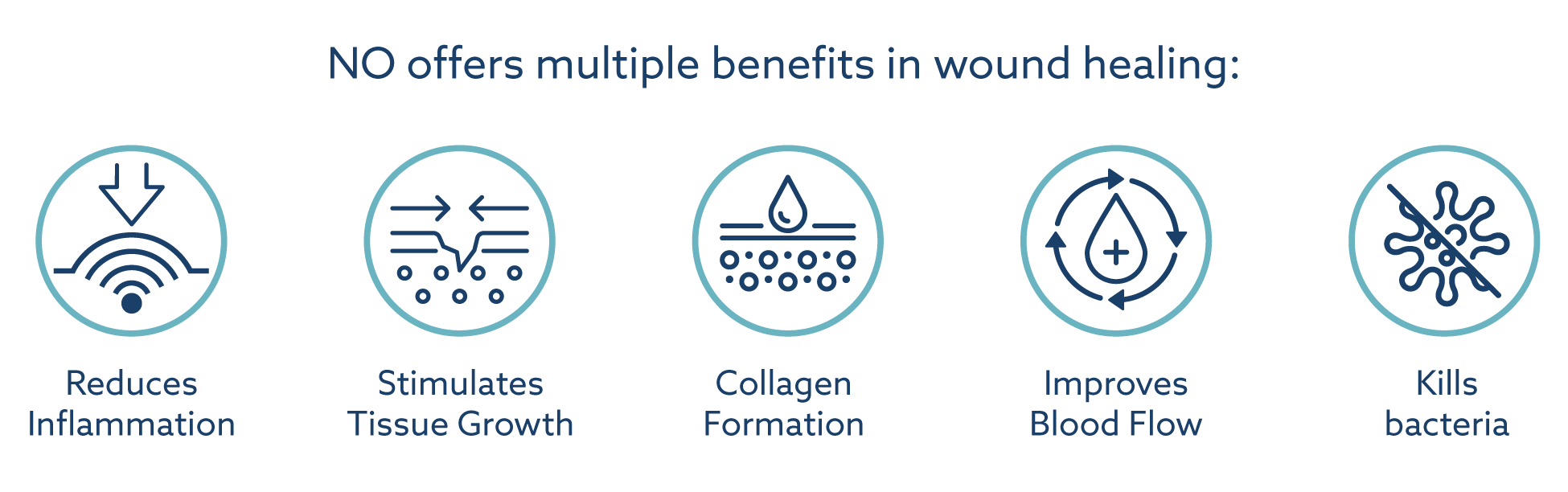
Nitric oxide (NO) is produced naturally in the body and participates in vascular, immune, antimicrobial, and tissue-repair signaling. In wound healing, published research describes roles for NO in blood flow, inflammation, cell proliferation, collagen formation, angiogenesis, antimicrobial activity, and remodeling.
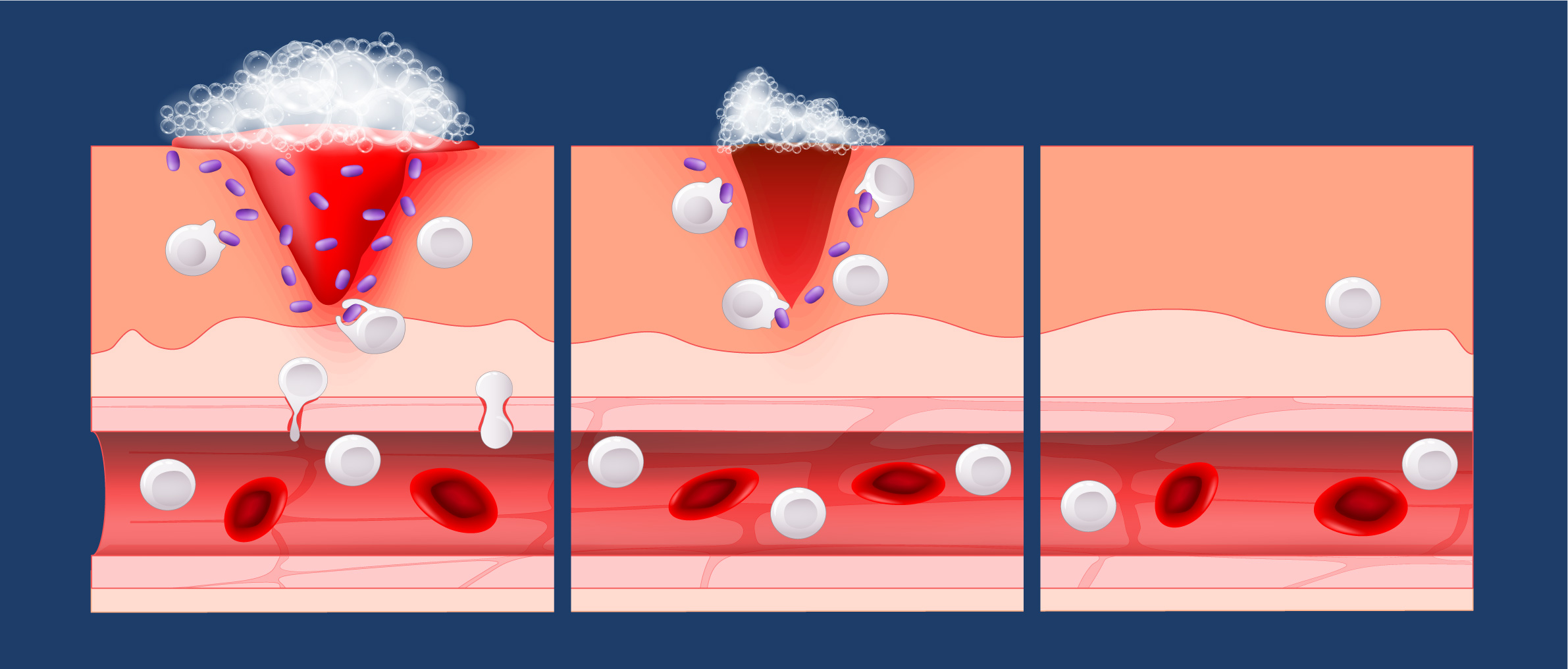
These biological roles make local NO delivery an important area of wound research. They also create an engineering problem: NO is a short-lived, highly reactive gas. A useful topical system must generate an appropriate amount at the point of care, distribute it across an irregular wound surface, limit loss to the surrounding air, and fit into clinical practice.
What the research shows
NO has been evaluated in laboratory models, animal studies, biomaterials research, and human wound studies. The literature supports biological plausibility and has produced encouraging findings across several delivery approaches. Results from one formulation or delivery system, however, cannot be assumed to apply to another. Dose, release profile, exposure time, wound type, and study design all matter.
The original white paper highlighted several examples from the broader nitric-oxide literature: a double-blind controlled study that reported improved healing across several wound and surgical applications; the observer-blinded ProNOx1 diabetic-foot-ulcer study, which reported median percentage area reduction of 88.6% with nitric-oxide-generating treatment and 46.9% with control at 12 weeks in the intention-to-treat population; and reports involving infected, non-healing wounds. These studies evaluated different formulations and delivery systems. They support continued investigation of nitric oxide, but they are not evidence that NOX1416 will produce the same outcomes.
This is why NOxy separates evidence by study type. Scientific reviews establish the broader biological framework. In vitro and ex vivo studies answer controlled mechanistic questions. Retrospective analyses describe associations in real-world care. Product-specific clinical studies are required to establish the safety and effectiveness of an investigational therapy.
The central delivery challenges


1. Generate nitric oxide where care happens
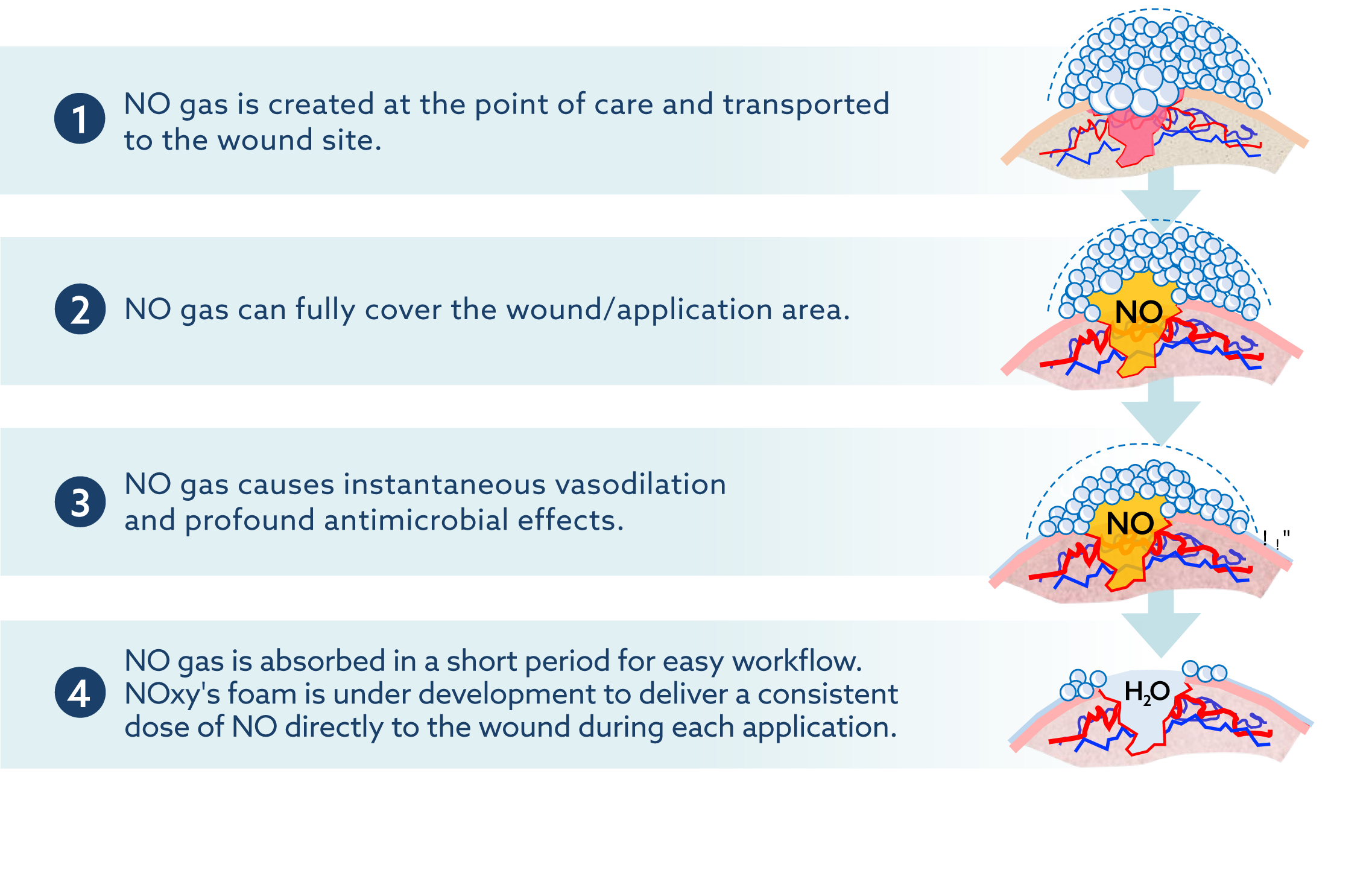
Because NO reacts rapidly with air and biological fluids, producing it centrally and transporting it to the wound can require specialized storage, equipment, or handling. Point-of-care generation is intended to avoid storing and transporting NO as a finished gas.
2. Control when and how it is released
Release that is too rapid, too slow, intermittent, or uneven may change the amount of NO available to the tissue. A delivery platform therefore needs reproducible chemistry and a defined application procedure.
3. Cover an irregular wound surface
Wounds vary in size, depth, contour, location, and exudate. A topical system should contact the treatment area without depending on a single wound shape. Foam offers a potential way to conform to surface geometry while maintaining close contact during application.
4. Reduce loss to the surrounding environment
NO diffuses readily. A delivery medium must balance release from the formulation with retention at the application surface. The objective is not simply to generate NO, but to present it where and when it is intended to act.
5. Fit into the flow of care
Chronic wound treatment already requires assessment, cleansing, pressure relief or compression when indicated, infection management, dressings, documentation, and follow-up. A new therapy must be practical for patients, caregivers, and clinicians and compatible with the other elements of the care plan.


NOxy’s foam-based approach
NOxy’s platform keeps the reactive components separate during storage. At use, the components combine as a topical foam and generate nitric oxide at the application site. The foam is designed to cover the target surface during a defined, five-minute application and then be removed before the prescribed wound cover is applied.
The development goals are straightforward:
- Generate nitric oxide at the point of care rather than store it as a gas
- Distribute the reacting formulation across the treatment surface
- Maintain contact for a defined application period
- Avoid dependence on a proprietary wound cover
- Fit into clinical workflows and support the potential for future administration outside specialized treatment centers, subject to regulatory review and approved labeling
These are design objectives, not established clinical claims. NOX1416 remains investigational. Its safety and effectiveness have not been established, and it has not been approved by FDA.
Since the original paper was published, NOxy completed its first-in-human safety study and FDA acknowledged that the clinical program is in Phase 2. The active U.S. IND permits the sponsor’s clinical development to proceed. These milestones do not establish efficacy or regulatory approval.
Why the foam matters
The scientific opportunity of nitric oxide and the engineering challenge of delivering it are inseparable. A molecule with broad biological relevance is useful only if a product can deliver a controlled exposure reproducibly, safely, and practically. NOxy’s research program therefore examines both sides of the problem: the chemistry and biological activity of the platform, and the clinical outcomes that matter to people living with chronic wounds.
References
- Kandhwal M, et al. Understanding the Potential Role and Delivery Approaches of Nitric Oxide in Chronic Wound Healing Management. Current Pharmaceutical Design. 2021. https://doi.org/10.2174/1381612826666201026152209
- Chavhan MM, et al. Therapeutic Role of Nitric Oxide in Diabetic Wound Healing: A Systematic Review. Journal of Pharmaceutical Research International. 2021. https://doi.org/10.9734/JPRI/2021/v33i33B31798
- Malone-Povolny MJ, Maloney SE, Schoenfisch MH. Nitric Oxide Therapy for Diabetic Wound Healing. Advanced Healthcare Materials. 2019. https://doi.org/10.1002/adhm.201801210
- Yu H, et al. Recent developments in nitric oxide-releasing biomaterials for biomedical applications. Medical Gas Research. 2019. https://doi.org/10.4103/2045-9912.273956
- Chernoff GW. The Utilization of a Nitric Oxide Generating Serum for Improving Vascularity in Wound Healing. Surgical Case Reports. 2020.
- Edmonds ME, et al. Multicenter, randomized controlled, observer-blinded study of a nitric oxide generating treatment in foot ulcers of patients with diabetes—ProNOx1 study. Wound Repair and Regeneration. 2018. https://pubmed.ncbi.nlm.nih.gov/29536674/
- Oliver S, et al. More than skin deep: using polymers to facilitate topical delivery of nitric oxide. Biomaterials Science. 2021. https://doi.org/10.1039/D0BM01197E
- Poh WH, Rice SA. Recent Developments in Nitric Oxide Donors and Delivery for Antimicrobial and Anti-Biofilm Applications. Molecules. 2022. https://doi.org/10.3390/molecules27030674
- Miller CM, et al. U.S. Patents 10,052,348 and 10,751,364. 2018–2020.
- Nguyen HM, et al. Biomedical materials for wound dressing: recent advances and applications. RSC Advances. 2023. https://doi.org/10.1039/D2RA07673J